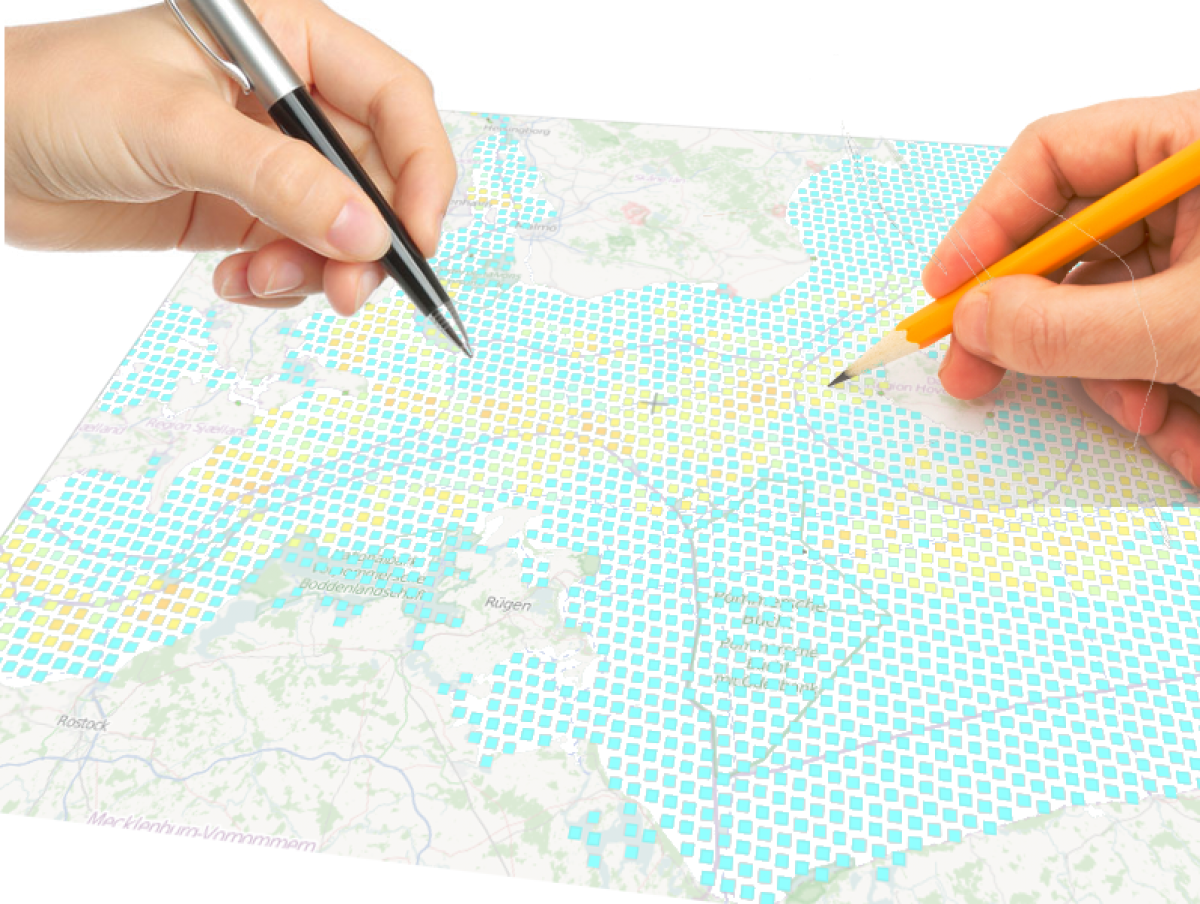
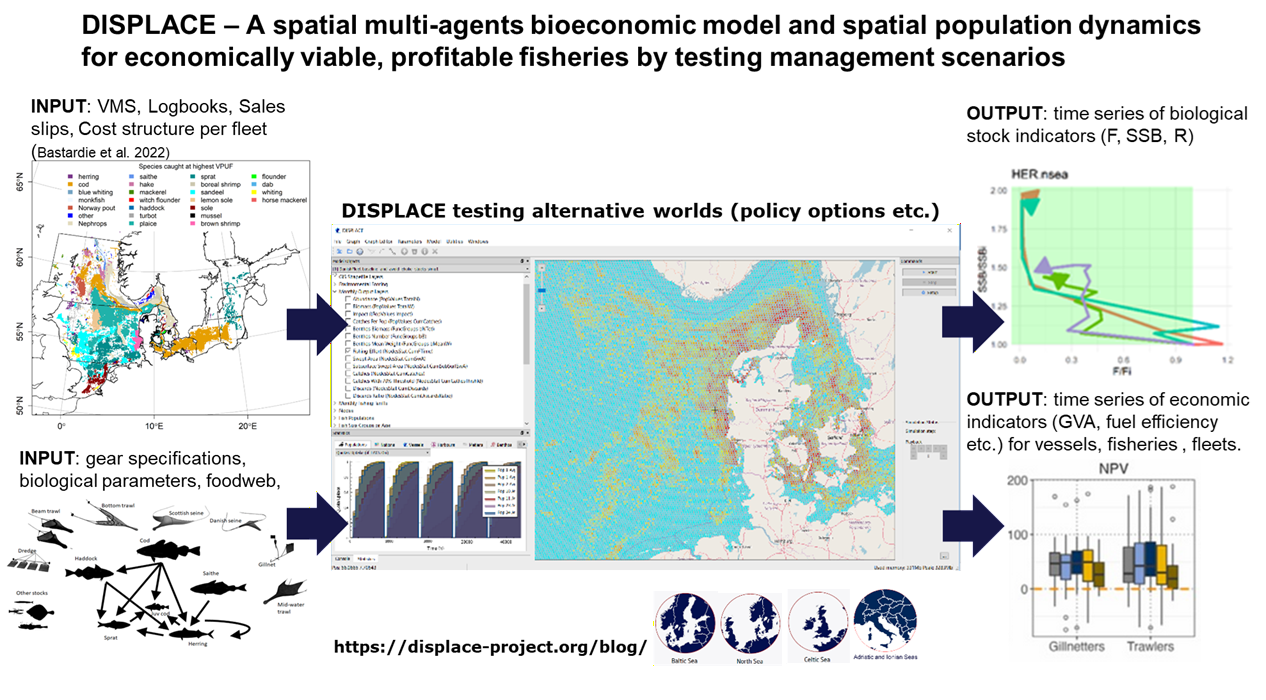
The European marine space is experiencing claims from different users. Bottom trawling faces restriction under the Biodiversity Strategy 2030; offshore wind expansion displaces fishing grounds under the REPowerEU plan; and the sector must decarbonise under the Green Deal, all while stocks may redistribute under climate change. These policies, individually rational, generate spatial trade-offs when implemented simultaneously, yet current assessment frameworks evaluate them in isolation.
Drawing on a decade of development of the DISPLACE individual-based spatial bio-economic model and its application across five European case studies (Baltic Sea, North Sea, Kattegat, Adriatic, Ionian Sea), we present an integrated framework to quantify these trade-offs. We demonstrate three key findings:
First, not all bottom trawling is equal; gear-specific seabed impact assessments (Eigaard et al. 2017; Rijnsdorp et al. 2020) show that differentiated restrictions outperform blanket closures in both ecological and economic terms.
Second, stock recovery is the most effective decarbonisation lever; rebuilding stocks may reduce fuel use intensity more than technological innovation alone (Bastardie et al. 2022), creating a virtuous cycle between biodiversity and climate objectives.
Third, spatial displacement from offshore wind and MPAs produces heterogeneous impacts; vessel-level modelling reveals that aggregate fleet indicators mask significant distributional effects, with small-scale coastal vessels disproportionately affected (Nielsen et al. 2026).
We argue that resolving the “spatial squeeze” requires moving from sequential to simultaneous policy assessment, in which climate, biodiversity, and energy objectives are evaluated within a single spatially explicit bio-economic framework. We propose operational pathways for implementing this approach, for example, within the ICES advisory process and the STECF evaluation framework, drawing on lessons from the SEAwise project and recent STECF evaluations of spatial management measures.
Details in:
Bastardie, F., Salvany, L., Cooper, A. M., & Carvalho, N. (2024). A roadmap to reduce the risk of overexploiting EU marine living resources in a changing ocean. Frontiers in Marine Science, 11, 1352500. https://doi.org/10.3389/fmars.2024.1352500
Bastardie, F., Hornborg, S., Ziegler, F., Gislason, H., & Eigaard, O. R. (2022). Reducing the Fuel Use Intensity of Fisheries: Through Efficient Fishing Techniques and Recovered Fish Stocks. Frontiers in Marine Science, 9, 817335. https://doi.org/10.3389/fmars.2022.817335
Bastardie, F., Feary, D. A., Brunel, T., Kell, L. T., Döring, R., Metz, S., Eigaard, O. R., Basurko, O. C., Bartolino, V., Bentley, J., Berges, B., Bossier, S., Brooks, M. E., Caballero, A., Citores, L., Daskalov, G., Depestele, J., Gabiña, G., Aranda, M., . . . Van Vlasselaer, J. (2022). Ten lessons on the resilience of the EU common fisheries policy towards climate change and fuel efficiency – A call for adaptive, flexible and well-informed fisheries management. Frontiers in Marine Science, 9, 947150. https://doi.org/10.3389/fmars.2022.947150
Bastardie, F., Astarloa, A., Binch, L., Bitetto, I., Damalas, D., Depestele, J., Hernvann, P. Y., Lehuta, S., Letschert, J., Maina, I., Mahévas, S., Papantoniou, G., Püts, M., Romagnoni, G., Spedicato, M. T., Sys, K., Tsikopoulou, I., Van Hoey, G., Zupa, W., . . . Rindorf, A. (2025). Anticipating how spatial fishing restrictions in EU waters perform to protect marine species, habitats, and dependent fisheries. Frontiers in Marine Science, 12, 1629180. https://doi.org/10.3389/fmars.2025.1629180
Eigaard, O. R., Bastardie, F., Hinzen, N. T., Buhl-Mortensen, L., Mortensen, P. B., Catarino, R., Dinesen, G. E., Egekvist, J., Fock, H., Geitner, K., Gerritsen, H., González, M. M., Jonsson, P., Kavadas, S., Laffargue, P., Lundy, M., Gonzalez-Mirelis, G., Nielsen, J. R., Papadopoulou, N., … Rijnsdorp, A. D. (2017). The footprint of bottom trawling in European waters: distribution, intensity, and seabed integrity. ICES Journal of Marine Science, 74(3), 847-865.
Nielsen, J. R., Olsen, J., Nielsen, A., Bastardie, F., & Egekvist, J. (2026). Retrospective analyses of offshore wind farm impacts on fisheries and benthic habitat interactions. Frontiers in Marine Science, 13, 1748431. https://doi.org/10.3389/fmars.2026.1748431
Rijnsdorp, A. D., Hiddink, J. G., Van Denderen, P. D., Hintzen, N. T., Eigaard, O. R., Valanko, S., Bastardie, F., Bolam, S. G., Boulcott, P., Egekvist, J., Garcia, C., Van Hoey, G., Jonsson, P., Laffargue, P., Nielsen, J. R., Piet, G. J., Sköld, M., & Van Kooten, T. (2020). Different bottom trawl fisheries have a differential impact on the status of the North Sea seafloor habitats. ICES Journal of Marine Science, 77(5), 1772-1786. https://doi.org/10.1093/icesjms/fsaa050


