Most fisheries management studies ask: what will happen if we keep fishing as we do? We asked a different question, putting the goal first: What needs to change for both marine biodiversity and fisheries´profit to increase?
We fed two decades of fisheries science into a Bayesian network adapted to EU fisheries. Then we made the best outcome certain and let the model work backwards. This “reverse engineering” showed us what a successful future would look like.
The answer was indicative. Fishing effort on benthic habitats would need to go down. Of 100 possible futures where biodiversity and profit both rise in the EU, 73 include a cut in benthic effort. Almost none include more of it. For the pelagic fleet, 53 out of 100 successful futures show reduced effort. In those successful futures, habitat damage also falls from 77% to 48%. The sea recovers. So does profit.
We also tested the worst case. More benthic effort would lead to profit loss in 61 of the 100 possible futures, and biodiversity loss in 81 of them.
Both tests agree: The path to success would run through less benthic effort. Strong policy would make it happen. If we want more from the sea, we will likely need to leave more of the sea alone.
See the “reverse engineering” (i.e. work backwards to move forward!) study here (Open Access Version) and cite it with:
Bastardie, F., & Brown, E. J. (2021). Reverse the declining course: A risk assessment for marine and fisheries policy strategies in Europe from current knowledge synthesis. Marine Policy, 126, 104409. https://doi.org/10.1016/j.marpol.2021.104409
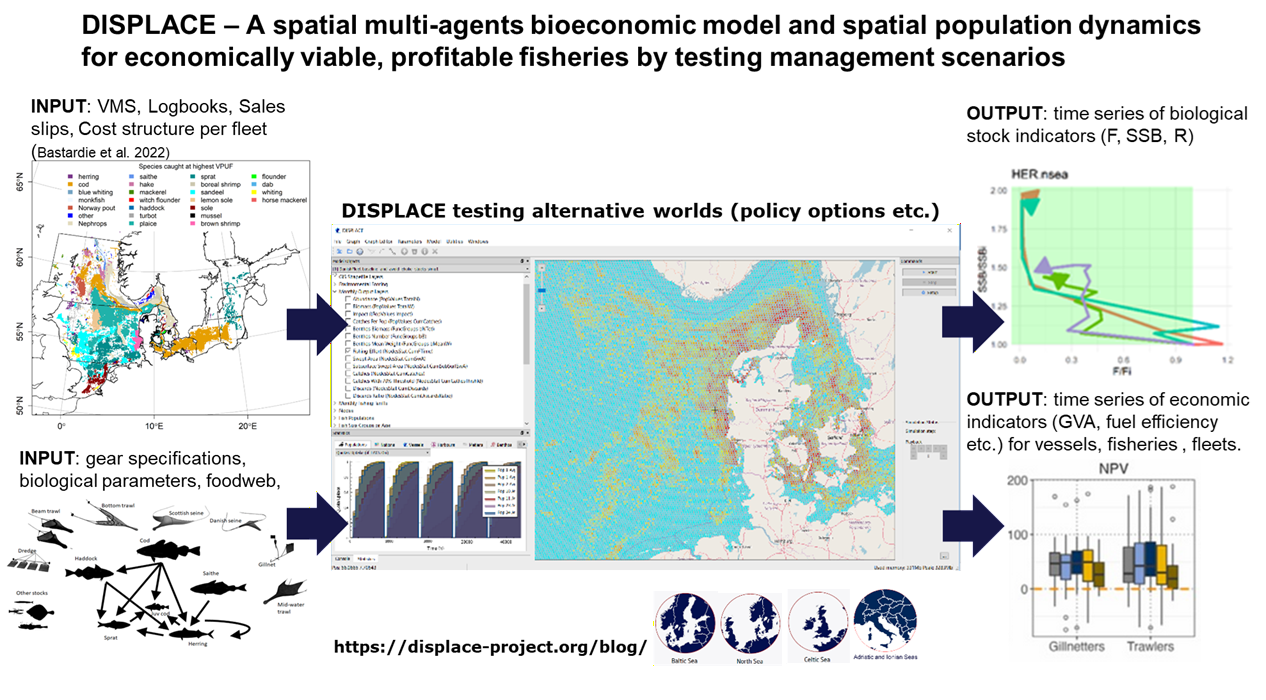
AI-generated vision for a DISPLACE dashboard: testing fleet economy, seafood provisioning and environmental performances
This is part of the narrative around the virtuous circle: Effort cuts avoid damaging the seafloor integrity > Habitats support the fish we want to catch > Recovered species make each unit of effort more productive > Lower costs stack on top of higher value > etc.
However, the trap is timing. Individual fishers benefit from fishing less only after the stock has recovered, but recovery requires everyone to ease off at once. The market doesn’t provide that coordination. Strong regulation would instead likely provide it.
(Disclaimer: This study was a synthesis of existing knowledge expressed as probabilities… of course not a forecast)
New fishing technologies designed to protect marine environments show promise, but their success relies on more than just invention. A 2024 study by the European Parliament (https://www.europarl.europa.eu/stoa/en/document/EPRS_STU(2024)762843) examined alternatives to bottom trawling in EU Marine Protected Areas and found a significant barrier: voluntary uptake is extremely low.
The core issue is short-term economic. Most current innovations do not match the catch efficiency of traditional gear. For fishers, switching means potentially lower yields and higher costs without immediate compensation. As a result, many continue using established methods to maintain their income. In some cases, this leads to increased effort to make up for lost catch, which can negate environmental benefits.
If it costs money now, it won’t happen, even if it saves more fish for later.
The report suggests that, because industry adoption has stalled in the absence of financial incentives, the most effective solutions may need to be mandatory rather than optional. It also highlights that policy frameworks must address the socioeconomic reality of fisheries. True sustainability likely requires a balanced approach in which environmental rules are paired with support mechanisms to ensure fishers are not left bearing the full cost of the transition.
However, the debate often misses a crucial long-term perspective: protecting marine habitats is not just an ecological goal, but a safeguard for the fisheries that depend on them. When habitats are degraded, they can no longer sustain the levels of exploitation needed to meet current catches. This fundamentally narrows the supposed trade-off between conservation and fishing; in the long run, one cannot exist without the other. Therefore, sustainable investment and the adoption of innovative technologies cannot succeed unless exploitation is balanced with the fish resources. Without this equilibrium, short-term gains risk leading to long-term collapse.
In the European context, this points to a clear conclusion: technological innovation is necessary, but it must be supported by smart policy that aligns conservation goals with the economic stability of the fishing sector. Without this alignment, good ideas risk remaining unused.
STOA (2024). Exploring the viability of innovative fishing technologies as an alternative to bottom trawling in European marine protected areas: An environmental and socioeconomic analysis 2024. Author: Bastardie F. for STOA Panel for the Future of Science and Technology (Brussels: The European Parliament).
Bastardie, F., Salvany, L., Cooper, A. M., & Carvalho, N. (2024). A roadmap to reduce the risk of overexploiting EU marine living resources in a changing ocean. Frontiers in Marine Science, 11, 1352500. https://doi.org/10.3389/fmars.2024.1352500
The European marine space is experiencing claims from different users. Bottom trawling faces restriction under the Biodiversity Strategy 2030; offshore wind expansion displaces fishing grounds under the REPowerEU plan; and the sector must decarbonise under the Green Deal, all while stocks may redistribute under climate change. These policies, individually rational, generate spatial trade-offs when implemented simultaneously, yet current assessment frameworks evaluate them in isolation.
Drawing on a decade of development of the DISPLACE individual-based spatial bio-economic model and its application across five European case studies (Baltic Sea, North Sea, Kattegat, Adriatic, Ionian Sea), we present an integrated framework to quantify these trade-offs. We demonstrate three key findings:
First, not all bottom trawling is equal; gear-specific seabed impact assessments (Eigaard et al. 2017; Rijnsdorp et al. 2020) show that differentiated restrictions outperform blanket closures in both ecological and economic terms.
Second, stock recovery is the most effective decarbonisation lever; rebuilding stocks may reduce fuel use intensity more than technological innovation alone (Bastardie et al. 2022), creating a virtuous cycle between biodiversity and climate objectives.
Third, spatial displacement from offshore wind and MPAs produces heterogeneous impacts; vessel-level modelling reveals that aggregate fleet indicators mask significant distributional effects, with small-scale coastal vessels disproportionately affected (Nielsen et al. 2026).
We argue that resolving the “spatial squeeze” requires moving from sequential to simultaneous policy assessment, in which climate, biodiversity, and energy objectives are evaluated within a single spatially explicit bio-economic framework. We propose operational pathways for implementing this approach, for example, within the ICES advisory process and the STECF evaluation framework, drawing on lessons from the SEAwise project and recent STECF evaluations of spatial management measures.
Details in:
Bastardie, F., Salvany, L., Cooper, A. M., & Carvalho, N. (2024). A roadmap to reduce the risk of overexploiting EU marine living resources in a changing ocean. Frontiers in Marine Science, 11, 1352500. https://doi.org/10.3389/fmars.2024.1352500
Bastardie, F., Hornborg, S., Ziegler, F., Gislason, H., & Eigaard, O. R. (2022). Reducing the Fuel Use Intensity of Fisheries: Through Efficient Fishing Techniques and Recovered Fish Stocks. Frontiers in Marine Science, 9, 817335. https://doi.org/10.3389/fmars.2022.817335
Bastardie, F., Feary, D. A., Brunel, T., Kell, L. T., Döring, R., Metz, S., Eigaard, O. R., Basurko, O. C., Bartolino, V., Bentley, J., Berges, B., Bossier, S., Brooks, M. E., Caballero, A., Citores, L., Daskalov, G., Depestele, J., Gabiña, G., Aranda, M., . . . Van Vlasselaer, J. (2022). Ten lessons on the resilience of the EU common fisheries policy towards climate change and fuel efficiency – A call for adaptive, flexible and well-informed fisheries management. Frontiers in Marine Science, 9, 947150. https://doi.org/10.3389/fmars.2022.947150
Bastardie, F., Astarloa, A., Binch, L., Bitetto, I., Damalas, D., Depestele, J., Hernvann, P. Y., Lehuta, S., Letschert, J., Maina, I., Mahévas, S., Papantoniou, G., Püts, M., Romagnoni, G., Spedicato, M. T., Sys, K., Tsikopoulou, I., Van Hoey, G., Zupa, W., . . . Rindorf, A. (2025). Anticipating how spatial fishing restrictions in EU waters perform to protect marine species, habitats, and dependent fisheries. Frontiers in Marine Science, 12, 1629180. https://doi.org/10.3389/fmars.2025.1629180
Eigaard, O. R., Bastardie, F., Hinzen, N. T., Buhl-Mortensen, L., Mortensen, P. B., Catarino, R., Dinesen, G. E., Egekvist, J., Fock, H., Geitner, K., Gerritsen, H., González, M. M., Jonsson, P., Kavadas, S., Laffargue, P., Lundy, M., Gonzalez-Mirelis, G., Nielsen, J. R., Papadopoulou, N., … Rijnsdorp, A. D. (2017). The footprint of bottom trawling in European waters: distribution, intensity, and seabed integrity. ICES Journal of Marine Science, 74(3), 847-865.
Nielsen, J. R., Olsen, J., Nielsen, A., Bastardie, F., & Egekvist, J. (2026). Retrospective analyses of offshore wind farm impacts on fisheries and benthic habitat interactions. Frontiers in Marine Science, 13, 1748431. https://doi.org/10.3389/fmars.2026.1748431
Rijnsdorp, A. D., Hiddink, J. G., Van Denderen, P. D., Hintzen, N. T., Eigaard, O. R., Valanko, S., Bastardie, F., Bolam, S. G., Boulcott, P., Egekvist, J., Garcia, C., Van Hoey, G., Jonsson, P., Laffargue, P., Nielsen, J. R., Piet, G. J., Sköld, M., & Van Kooten, T. (2020). Different bottom trawl fisheries have a differential impact on the status of the North Sea seafloor habitats. ICES Journal of Marine Science, 77(5), 1772-1786. https://doi.org/10.1093/icesjms/fsaa050