Parts of the EU fishing fleet are under real pressure from marine diesel costs (EUMOFA), and the sector must decarbonise regardless. Facing both without pitting them against each other would keep progress moving.
Encouraging news from our data analysis and modelling work at DTU Aqua: we have already identified some effective levers. They don’t wait on a technological breakthrough, and they don’t require choosing between viable fisheries and energy transition goals.
What the data shows
In the same waters (for example, the ones visited by the Danish fleet), the difference gear choice makes is measurable:
- Otter bottom trawlers, fishing a mix of Nephrops, cod, plaice and flounder, may burn 0.83 litres of fuel per kilogram of fish landed, generating €4.19 of revenue per litre.
- Vessels using passive gear (gillnets, hooks, etc.) burn only 0.17 to 0.24 l/kg, and may yield up to €9.57 per litre.
That is a 70–80% fuel saving and more than double the revenue per litre. Two vessels leave the same harbour; one operates at roughly half the energy cost per fish on the dish plate (and those fisheries also use different vessel sizes, see details in Bastardie et al. 2022)
And the gap is arguably even larger EU-wide: in the Mediterranean, bottom-trawling fuel use intensity runs considerably higher than the Danish figures above, so if anything this comparison understates the European potential.
The real policy difficulty: the shocks
To be fair to everyone involved: fuel-price shocks do call for emergency relief. Fishing communities are real, food supply is real, and it is expected that no responsible government would let a sector collapse mid-crisis.
The difficulty is that emergency relief also removes the incentive to make the structural change that would end the vulnerability, and the sector ends up needing relief again at the next price spike. Getting both right simultaneously (solidarity in the short term, energy transition in the medium term) is hard policy design. It is also, we would argue, the central design task of the EU Energy Transition Partnership.
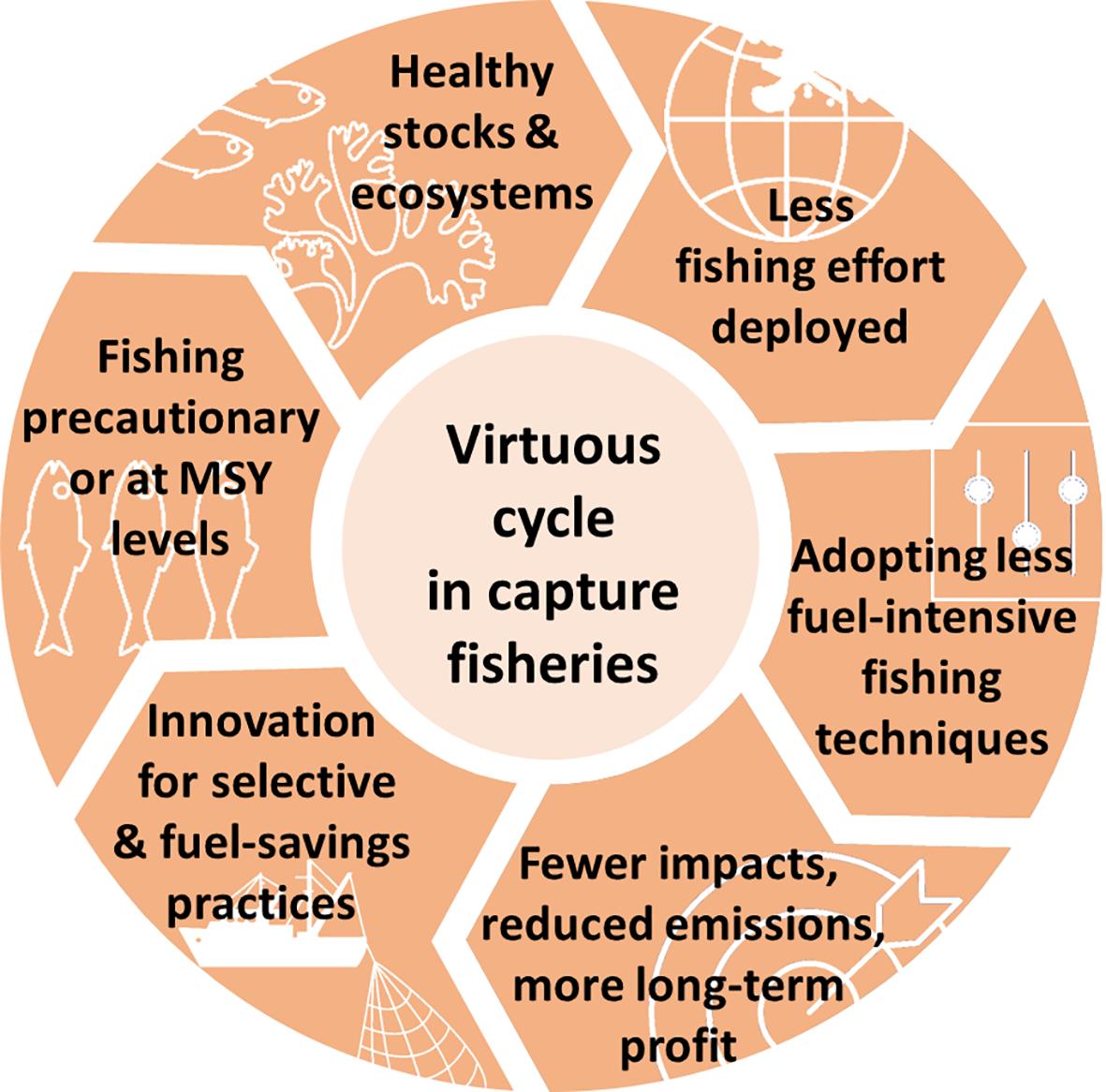
Our modelling consistently points to the same ranking of levers: stock recovery combined with a gear change would reduce fuel-use intensity more than any engine upgrade would in the short term. Supporting fuel-intensive effort while stocks rebuild means paying twice for the same fish (1: for the fuel, 2: for the rebuild). The transition should be seen less as a cost imposed on the sector and more as the exit from the crisis loop.
Likely three concrete choices, available now
- Transition-linked aid? Emergency support stays (for example as in here), but would come with a committed pathway: continue working on, and financing, drag-reduction technology and “precision fishing“, with gear-switching plans agreed with producer organisations, phased realistically.
- Reward efficiency with access? Low-fuel, passive-gear fishers earning more euros per litre of fuel could receive preferential access, more fishing days, quota flexibility, etc., making efficiency profitable before the fuel bill punishes inefficiency.
- Capital support for retrofits, not just operating costs? Direct EMFAF-type funding and investment toward hybrid retrofits, gear changes, and vessel adaptation, so today’s aid builds the fleet of tomorrow instead of renting the fleet of yesterday (Bastardie et al. 2026).
Stakeholders would agree that each of these would be implementable within existing instruments, and would make sure that each has precedent elsewhere in the EU’s decarbonisation toolbox. Consultation works point to industry readiness, not only a lack of flexibility in the policy framework, as the primary missing feature. The primary obstacles are likely a widespread resistance to change, driven by the high costs and low uptake of commercial feasibility studies. Ultimately, operators’ pervasive fear of losing market access during the transition likely stalls progress. This includes the challenge of gaining flexibility to align each operator’s quota portfolio and capacity with available marine living resources.
When energy prices spike, fuel-dependent industries adjust in stages: absorbing the shock through margins, then coping in the short term, and finally adapting structurally. Cost-effective efficiency investments are routinely delayed because of uncertainty, irreversibility, and the “option value of waiting” (Gerarden et al., 2017).
In fisheries, fuel price shocks manifest primarily as behavioural coping: shifted effort and fishing closer to port, fewer trips and fewer exploratory trips, and accepting lower catches (for example, see Abernethy et al., 2010). In contrast, Structural changes would mean new gear, vessels, and techniques. Today, the EU fleet remains stuck in Phase 2: coping, but not transforming.
An open question
What would make transition-linked support workable in practice, not just on paper? Which conditions feel fair? This is a design problem best solved by consulting the people who will live under the rules. But even when considering alternative viewpoints, one should not ignore the numbers science studies brings to the table.
References and details:
Abernethy, K. E., Trebilcock, P., Kebede, B., Allison, E. H., & Dulvy, N. K. (2010). Fuelling the decline in UK fishing communities? ICES Journal of Marine Science, 67(5), 1076-1085. https://doi.org/10.1093/icesjms/fsp289
Bastardie, F., Hornborg, S., Ziegler, F., Gislason, H., & Eigaard, O. R. (2022). Reducing the Fuel Use Intensity of Fisheries: Through Efficient Fishing Techniques and Recovered Fish Stocks. Frontiers in Marine Science, 9, 817335. (Open access.)
Bastardie, F., Wakeford, R. C., Torreele, E., Aranda, M., Doering, R., Ligas, A., Mele, I., Castresana, J., Gabiña, G., Maes, S. M., Sabatella, R., & Malvarosa, L. (2026). How to ensure sustainable fisheries while renewing the EU fishing fleet for modernization and energy transition? Frontiers in Marine Science, 13, 1812898. https://doi.org/10.3389/fmars.2026.1812898 (Open access.)
Gerarden, Todd D., Richard G. Newell, and Robert N. Stavins. 2017. “Assessing the Energy-Efficiency Gap.” Journal of Economic Literature 55 (4): 1486–1525.


