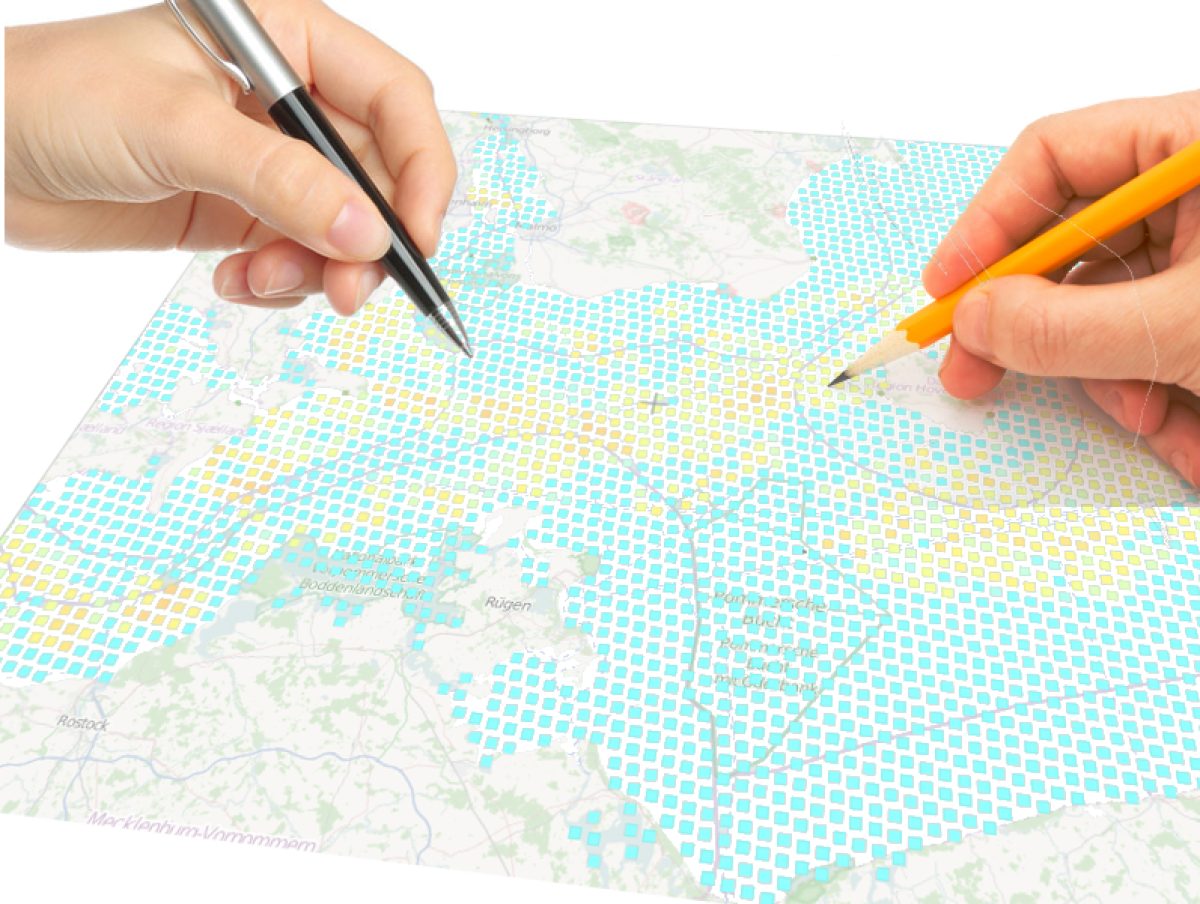
How to show that the modelled answer by DISPLACE beats the unmodeled guess?

Currently working on the following across several seas:

Step 1: Define the counterfactual properly. The “unmodeled guess” would be what policymakers would assume is absent in the model, and would be some combination of:

  • Persistence: effort and catches stay roughly where they were
  • Naïve closure arithmetic: a closure “protects” everything inside its boundary and costs the fleet proportionally to its footprint
  • Proportional redistribution: displaced effort spreads uniformly over the remaining grounds
  • Expert judgment: what experiential knowledge would say without simulation

The “naive” baseline assumes fishers don’t strategically adapt. That is DISPLACE’s whole point: fleet adaptation most likely occurs in response to area-based management by displacing effort and continuing to fish elsewhere. The comparison shows whether it is real.

Step 2: Use natural experiments where the truth is observable. Real closures happened after the model existed (Baltic cases, Kattegat, Mediterranean fishery-restricted areas). For those, we would retrieve before/after VMS tracks, logbooks, landings, and fuel data. We would then feed the model only data up to the year before the closure, let it predict the post-closure period, and score it. The unmodeled baseline would make the same prediction for the same period.

Step 3: Score on metrics where behaviour matters most.

  • Spatial allocation: what fraction of post-closure effort landed in the cells the model assigned it to, versus where persistence/proportional baselines put it? (use some metrics for that…)
  • Displacement distance and direction: did effort shift to the actual remaining grounds, at roughly the modelled magnitude?
  • Economics: revenue and fuel use per fishing fleet segment: compare mean absolute error for each predictor.
  • Probabilistic calibration: run stochastic simulation to capture uncertainties and compare with frequency-type statements… did the modelled frequencies match realised frequencies?

DISPLACE doesn’t need to be right; it needs to be less wrong than the guess. If a retrospective showed, say, that the model beat persistence by 30% on spatial allocation while the naive baseline missed displaced hotspots entirely, that would be a good case to demonstrate that taxpayer money is not misused.

Francois Bastardie on Twitter
Francois Bastardie
Francois Bastardie is a DTU-Aqua Senior Scientist and method developer in the Section of Ecosystem-based Marine Management with a Ph.D. in Biological Science. He has been involved in several national and EU Funded projects developing expertise in spatial fisheries and fisheries databases. He has a strong background in modeling fishing and the bio-economic dynamics including developing agent-based models for combining marine ecosystems and natural resource extraction models, fisheries economics in a mixed fisheries perspective. He has an experience of 10 years leading to more than 35 peer-reviewed publications by conducting scientific-based fisheries management evaluation with scenario-testing evaluation and simulations, including fleet dynamics and consequences on the economy of fisheries, population dynamics and fish stock assessment. He was in charge of the evaluation of some of the EU long-term fisheries management plans with consequent participation to ICES and STECF working groups, including giving advise from regional to international policy makers.

Author: Francois Bastardie

Francois Bastardie is a DTU-Aqua Senior Scientist and method developer in the Section of Ecosystem-based Marine Management with a Ph.D. in Biological Science. He has been involved in several national and EU Funded projects developing expertise in spatial fisheries and fisheries databases. He has a strong background in modeling fishing and the bio-economic dynamics including developing agent-based models for combining marine ecosystems and natural resource extraction models, fisheries economics in a mixed fisheries perspective. He has an experience of 10 years leading to more than 35 peer-reviewed publications by conducting scientific-based fisheries management evaluation with scenario-testing evaluation and simulations, including fleet dynamics and consequences on the economy of fisheries, population dynamics and fish stock assessment. He was in charge of the evaluation of some of the EU long-term fisheries management plans with consequent participation to ICES and STECF working groups, including giving advise from regional to international policy makers.